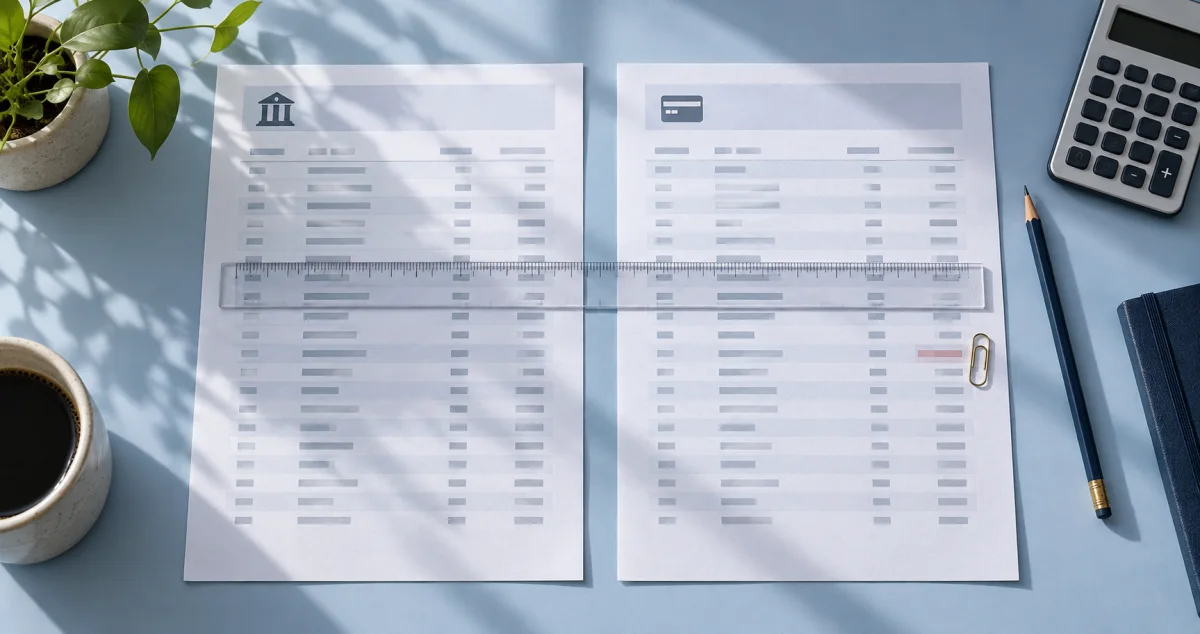
The book balance may differ from the bank statement because items have not reached the other side, or because of fees, errors and missing movements. Reconciliation does not force two numbers to match; it explains every difference until both are compared on the same basis.
Bridge the bank and ledger
The ledger shows SAR 52,000 and the bank statement SAR 48,300, with a SAR 3,000 deposit in transit and SAR 700 fees not recorded in the ledger. Adjusted bank: 48,300 + 3,000 = SAR 51,300. Adjusted ledger: 52,000 − 700 = SAR 51,300. The deposit is a timing difference; verified fees require an entry.
Two balances at one date
Reconciliation starts with two independent balances and adjusts for identified outstanding items. Timing differences remain on a follow-up list; bank fees or book errors require review and supported entries. Altering the statement is not a substitute for explaining the difference.
Start below the monthly total
With hundreds of movements, match clear references and amounts first, then investigate the remainder. Two equal transfers are not necessarily the same transaction; dates, beneficiaries and references prevent a false match concealing two unresolved items. A payment provider's net settlement may need a bridge to gross receipts and fees rather than a search for one identical amount.
Have another person review old and significant outstanding items and their treatment. Retain the original statement, reconciliation and approved entries together. If a transaction changes afterwards, reassess its effect; an earlier matched status is not permanent evidence that the revised position remains correct.
An unidentified deposit is not automatically revenue
The bank statement shows SAR 48,000 while the ledger shows SAR 50,000. A SAR 3,000 customer deposit is recorded but has not appeared on the statement; an outgoing SAR 1,000 payment is recorded but has not cleared. The adjusted bank balance is 48,000 + 3,000 − 1,000 = SAR 50,000. Timing explains the difference. Posting these transactions again would create a new error.
If there are also unrecorded bank charges, they require a supported ledger adjustment followed by another reconciliation. Mark each item as requiring a posting, awaiting bank clearance or needing investigation. The working paper becomes an actionable list and avoids a blanket “bank difference” entry used simply to force agreement.
Monitor the age of outstanding items. A deposit pending for one day differs from one missing for several weeks. The latter may reveal a wrong account reference, duplication or money never deposited. Carrying an item from last month's reconciliation does not prove it is valid; follow it through to an explained resolution.
For a receipt with no identified payer, retain the bank reference and date and investigate customer remittances. Do not allocate it by guesswork to the oldest invoice: that could lead to chasing a customer who paid while overlooking the one who did not. Use the appropriate temporary treatment and allocate the receipt once its owner is verified.
Classify a difference before posting
- Retain the period statement and identify its last included movement.
- Match amounts and references individually or in explainable batches.
- Classify items as timing, entry or question.
- Review aged items and approve the reconciliation with evidence.
Sources & further reading
Visit the original source to explore the concept and its wider context.
General educational content. Appropriate treatment depends on your business and accounting policies; consult your accounting professional when applying it to business records.